Post-workout stretches are the essential bridge between high-intensity training and optimal recovery. By systematically lengthening tightened muscle fibers and calming the nervous system, you reduce delayed onset muscle soreness (DOMS), improve long-term flexibility, and accelerate blood flow to damaged tissues, ensuring you are ready for your next session.
Key Takeaways: Why Stretching Matters
- Reduced Soreness: Stretching helps flush metabolic waste products from muscle tissue.
- Nervous System Regulation: Transitions the body from a “fight or flight” (sympathetic) state to “rest and digest” (parasympathetic).
- Mobility Gains: Consistent post-exercise lengthening improves your functional range of motion over time.
- Injury Prevention: Rebalances muscles that become chronically tight from repetitive exercise patterns.
The Science of Muscle Recovery Post-Exercise
When you train, you create microscopic tears in muscle fibers. While this is necessary for growth, it also triggers inflammation and stiffness. Static stretching after a workout is not about forcing your range; it is about restoring the resting length of your muscles.
Pro Tip: Focus on “passive” stretching here. Unlike dynamic warm-ups, you want to hold these stretches for 30–60 seconds to signal the brain to release tension in the muscle spindles.
The Recovery Matrix: Upper vs. Lower Body
To maximize your recovery, you must address the primary movers used during your specific workout.
| Muscle Group | Primary Benefit | Best Movement |
| Quadriceps | Reduces knee pressure | Standing Quad Stretch |
| Chest/Shoulders | Improves posture | Doorway Pec Stretch |
| Glutes/Hips | Relieves lower back tension | Pigeon Pose |
| Hamstrings | Enhances stride length | Seated Forward Fold |
5 Essential Post-Workout Stretches
1. The Pigeon Pose (Hips & Glutes)
The hips are a focal point for tension, especially after squatting or running. The Pigeon pose deeply targets the piriformis and gluteus medius.
- Execution: From a tabletop position, bring your right knee forward toward your right wrist. Extend your left leg straight back. Keep your hips square to the floor.
- A common bottleneck: If your hip is too tight, do not force it to the floor. Use a yoga block under your right glute for support.
2. Doorway Pec Stretch (Chest & Shoulders)
If you spend your day at a desk or finished a heavy push day (bench press/push-ups), your chest muscles are likely rounded forward.
- Execution: Place your forearm against a door frame with your elbow at a 90-degree angle. Step forward gently until you feel a deep stretch across the front of your shoulder.
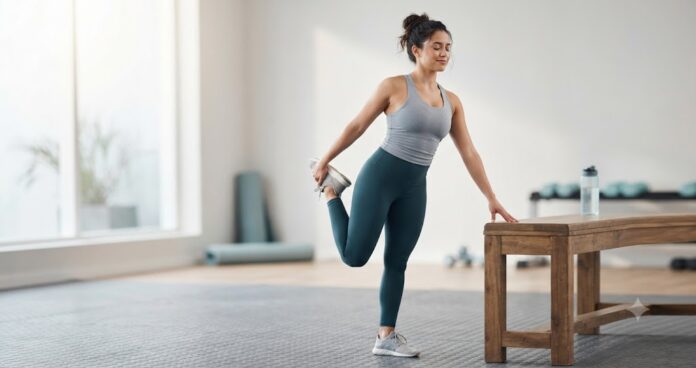
3. Standing Quad Stretch (Quadriceps)
Crucial for anyone involved in cycling, running, or HIIT training.
- Execution: Stand tall, grab your ankle, and pull your heel toward your glute. Keep your knees aligned—do not let the working knee splay outward.
- Expert Insight: Squeeze your glute on the side you are stretching. This triggers “reciprocal inhibition,” forcing the quad to relax more deeply.
4. Child’s Pose (Latissimus Dorsi & Lower Back)
This is the ultimate “reset” button for the central nervous system.
- Execution: Kneel on the floor, touch your big toes together, and sit back on your heels. Reach your arms as far forward as possible, resting your forehead on the mat.
5. Seated Hamstring Fold (Posterior Chain)
Hamstrings often become “short” and tight, which pulls on the pelvis and causes lower back pain.
- Execution: Sit with legs extended. Hinge at the hips—not the waist. Keep your spine neutral as you reach toward your shins.
Advanced Troubleshooting: When Recovery Stalls
If you find that stretching alone isn’t alleviating soreness, consider the following variables:
- Hydration status: Muscles that lack adequate electrolytes (specifically magnesium and potassium) are prone to cramping and stiffness, which makes post-workout stretching feel counterproductive.
- Blood flow: Before stretching, ensure your heart rate has returned to a near-resting state. If you stretch while your muscles are still inflamed and highly dilated from a heavy “pump,” you may experience excessive soreness.
- Consistency vs. Intensity: You don’t need to be a gymnast. The goal is to reach a point of “mild discomfort,” not sharp pain. If you feel sharp pain, you are likely overstretching the connective tissue rather than the muscle belly.
Expert Insight: If you have access to a [External Link: Foam Rolling Technique Guide], use it before you static stretch. Rolling acts as a self-myofascial release, breaking up adhesions in the fascia, which makes the subsequent static stretches significantly more effective.
Frequently Asked Questions (FAQ)
1. Should I stretch while my muscles are still hot?
Yes, but prioritize light movement. After a workout, your muscles are pliable, making this the best time to improve your flexibility. Avoid “bouncing” in your stretches, as this can trigger a stretch reflex and cause injury.
2. How long should I hold each stretch?
For recovery purposes, aim for 30 to 60 seconds. Research indicates that 30 seconds is the minimum threshold to induce a structural change in the muscle’s resting length.
3. Does stretching prevent DOMS completely?
While stretching cannot eliminate DOMS (Delayed Onset Muscle Soreness) entirely, it significantly mitigates the severity by improving circulation and reducing the mechanical tension placed on the fascia.
4. Can I overstretch?
Absolutely. Pushing into “pain” rather than “tension” can cause micro-tears in the tendons and ligaments, which are less vascularized than muscles and take much longer to heal.
5. What if I am too tired to stretch after a workout?
If you are physically or mentally exhausted, a 5-minute “legs-up-the-wall” pose is a superior, low-effort alternative that still encourages blood flow and nervous system recovery without requiring active exertion.
Ready to Elevate Your Recovery?
Recovery is not passive; it is a calculated part of your training program. By implementing these stretches consistently, you move from merely “surviving” your workouts to actively rebuilding your body for better performance.
Start by picking three of the movements above and committing to them after every session this week. Your joints and muscles will thank you during your next [Internal Link: Advanced Strength Training Routine]. If you want to dive deeper into how nutrition affects these recovery windows, check out our [Internal Link: Performance Nutrition Guide].