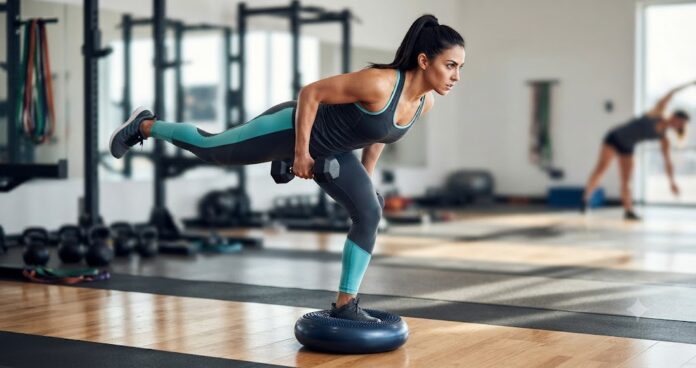
Athletes across all disciplines require exceptional balance to enhance performance, prevent injury, and improve agility. Integrating targeted stability training—such as single-leg deadlifts, BOSU ball squats, and medicine ball rotations—into your routine builds the core strength and proprioception necessary to excel under pressure and maintain control during high-intensity movements.
Why Balance is the Foundation of Athletic Mastery
Balance is often misunderstood as simply standing on one leg. In the athletic context, balance is dynamic stability. It is the ability to maintain center-of-mass control while moving through various planes of motion, dealing with external resistance, or recovering from an explosive jump.
When you lose your balance, you lose power. If your body is fighting to stay upright, it cannot channel maximum force into a sprint, a swing, or a tackle. By mastering balance, you optimize your kinetic chain, ensuring that every ounce of energy is directed toward your goal.
The Science of Proprioception and Neuromuscular Control
Balance relies on the nervous system’s ability to communicate with muscles in real-time. This is known as proprioception—your body’s internal map of where it exists in space. Training for balance isn’t just about “muscles”; it’s about “wiring.”
When you perform unstable exercises, you force your stabilizing muscles (the small, deep muscles around joints) to fire more rapidly. This reduces the latency between a stimulus (like a change in direction) and your reaction.
Pro Tip: Don’t train balance on a soft surface like a Bosu ball every time. The best athletes train on stable surfaces to build raw strength, then introduce instability to challenge their nervous system’s reaction times.
The Top 5 Balance Exercises for Athletes
1. Single-Leg Romanian Deadlift (RDL)
The RDL is the gold standard for posterior chain stability. It forces the glutes, hamstrings, and core to work in unison to keep you from toppling over.
- Execution: Stand on one leg, holding a kettlebell in the opposite hand. Hinge at the hips, keeping your back flat, while extending your free leg backward.
- Athletic Benefit: Directly translates to improved control during running, cutting, and jumping.
2. Lateral Bound to Stick
Lateral movement is where most non-contact injuries occur. This exercise trains you to land with stability.
- Execution: Start on one leg. Leap sideways as far as you can and land on the opposite leg, holding the landing for two seconds without wobbling.
- Athletic Benefit: Develops “eccentric braking strength”—the ability to stop movement quickly, which is critical for change-of-direction sports.
3. Single-Arm Farmer’s Carry
This is the ultimate test of “anti-lateral flexion” core strength.
- Execution: Hold a heavy weight in one hand and walk for 30–40 yards. Keep your torso perfectly upright.
- Athletic Benefit: Prevents the torso from collapsing during contact sports or high-speed maneuvers.
4. Bulgarian Split Squats
By elevating the rear foot, you isolate the front leg, forcing the hips and stabilizers to work overtime.
- Execution: Place one foot behind you on a bench. Drop your hips straight down, ensuring your knee tracks over your toes.
- Athletic Benefit: Corrects muscular imbalances between your left and right sides.
5. Medicine Ball Rotational Throws
Balance isn’t just about staying still; it’s about stability while generating rotation.
- Execution: Stand sideways to a wall, holding a medicine ball. Rotate explosively through your core and release the ball into the wall.
- Athletic Benefit: Teaches you to stay balanced while applying maximum force through the core.
Comparison of Balance Training Modalities
| Exercise Category | Primary Goal | Ideal For |
| Static Stability | Alignment/Control | Rehab & Beginners |
| Dynamic Stability | Movement Efficiency | Field/Court Athletes |
| Reactive Stability | Reflex/Proprioception | Combat & High-Speed Sports |
Troubleshooting Common Balance Bottlenecks
“I feel wobbly even with simple moves.”
This usually points to a weak core or tight ankles. Focus on ankle mobility drills and plank variations before adding external load to your balance work.
“My performance drops when I add weights.”
If you lose balance as soon as you grab a dumbbell, drop the weight. You are currently limited by your stability, not your strength. Master the bodyweight movement first, then introduce resistance incrementally.
Frequently Asked Questions
1. How many times a week should I train balance?
Two to three times a week is sufficient. Because balance training is taxing on the Central Nervous System (CNS), avoid doing it on heavy, high-volume lifting days.
2. Should I do balance work before or after a workout?
Do it at the beginning of your session, right after your dynamic warm-up. You want your nervous system to be fresh, not fatigued, to ensure maximum motor unit recruitment.
3. Do balance boards actually help athletes?
They are useful for ankle rehabilitation and proprioceptive drills, but they shouldn’t be the focus of your athletic training. Prioritize ground-based, multi-planar movements instead.
4. Can balance exercises help me run faster?
Yes. Improved stability means less energy “leaks” during your stride, leading to more efficient force production and increased top-end speed.
5. How do I know if I’m improving?
Look for the “Stick.” If you can transition into a movement and hold the landing position perfectly still for three seconds, you have successfully mastered that level of stability.
Take Control of Your Stability Today
Balance is a skill, not a static trait. If you aren’t training it, you are leaving performance on the table and increasing your risk of injury. Start by adding two of the exercises mentioned above to your next training session—focus on the “stick” and feel the difference in your movement quality.
Ready to take your athleticism to the next level? Start tracking your stability sessions this week and observe the immediate impact on your game-day performance.