Creating a successful lead generation funnel involves mapping your audience’s journey from stranger to loyal customer. By aligning high-value content with specific pain points at each stage—Awareness, Consideration, and Decision—you build trust and capture contact information, ultimately turning passive browsers into active, qualified leads for your business.
Understanding the Lead Generation Funnel
Think of your funnel not just as a marketing tool, but as a digital relationship builder. If you rush to ask for a sale before someone even knows who you are, they will leave. A successful funnel respects the customer’s pace.
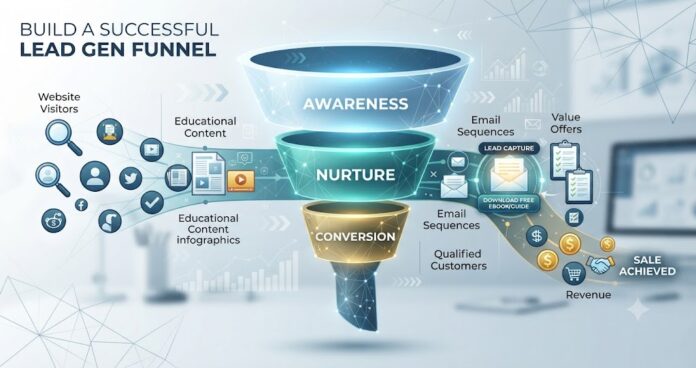
It is structured into three primary layers:
- Top of Funnel (TOFU): Attracting strangers and solving their immediate problems.
- Middle of Funnel (MOFU): Nurturing leads who know they have a problem and are looking for a solution.
- Bottom of Funnel (BOFU): Converting prospects who are ready to make a purchase decision.
Pro Tip: Your conversion rate depends on how effectively you tailor your messaging to these specific stages. Never use “Buy Now” language on a visitor who has just landed on your site for the first time.
Phase 1: Attracting Your Ideal Audience (TOFU)
At this stage, users are searching for answers, not products. Your goal is to provide value without friction.
Content Strategies for Attraction
- Educational Blog Posts: Solve specific, high-search-volume queries.
- Social Media Snippets: Share quick tips that lead back to longer content.
- Infographics: Highly shareable visual data that establishes your brand as an authority.
| Strategy | Goal | Typical Format |
| SEO Content | Reach | Blog post / Long-form guide |
| Social Media | Awareness | Short video / Carousel |
| Paid Ads | Traffic | Problem-aware ads |
Expert Insight: In practice, this means avoiding jargon. If a potential lead has to work hard to understand your content, they will bounce. Keep it conversational and focused entirely on their pain point.
Phase 2: Capturing and Nurturing (MOFU)
Once they are interested, you need to capture their details. The secret here is the Lead Magnet. You must offer something so valuable that they are happy to trade their email address for it.
High-Converting Lead Magnet Ideas
- Checklists: Simplify a complex process for the user.
- Templates: Give them a “shortcut” to solve a problem.
- Mini-Courses: A 3-day email series that builds trust over time.
[Internal Link: Best Practices for Email Marketing Automation]
A common bottleneck is failing to follow up after the download. If you capture a lead but don’t have an automated email sequence ready, that lead will turn cold within 48 hours.
Phase 3: Converting to Customers (BOFU)
This is where the transition from “lead” to “revenue” happens. Your content here must be focused on proof, trust, and reduction of risk.
Effective Conversion Tactics
- Case Studies: Show, don’t just tell. Document how you helped someone similar achieve results.
- Comparison Pages: Compare your solution against common alternatives to highlight your unique value proposition.
- Limited-Time Offers: Use urgency to encourage a decision.
[External Link: Principles of Persuasion and Conversion Optimization]
Scaling Your Funnel with Data
You cannot improve what you do not measure. A successful funnel is an iterative process.
| Metric | Why it Matters | Action if Low |
| Traffic to Lead | Attractiveness of lead magnet | Improve headline/offer |
| Lead to Customer | Trust and fit | Improve nurture sequence |
Pro Tip: Use A/B testing on your landing page headlines. Even a small change, like switching from “Sign Up” to “Get Your Free Guide,” can significantly boost your capture rate.
Frequently Asked Questions
1. How long does it take to see results?
Lead generation is a compounding effort. While paid ads can generate leads in hours, organic content-based funnels usually take 3–6 months to gain significant traction.
2. What is the most important part of the funnel?
The “Offer” (Lead Magnet) is critical. If your lead magnet doesn’t solve a burning problem for your audience, your funnel will fail regardless of your traffic volume.
3. How many emails should be in a nurture sequence?
A standard sequence is 3–5 emails. The first delivers the resource, the second provides more value, the third connects your service to their problem, and the last makes the offer.
4. Should I use one funnel for everyone?
No. Segmenting your leads based on how they entered your funnel (e.g., via a blog post about X vs. a video about Y) allows for highly personalized follow-ups.
5. How do I know if my funnel is broken?
Check your conversion rates at each step. If you have traffic but no leads, your landing page is the issue. If you have leads but no sales, your email sequence or product offer needs work.
Ready to start? Take the first step today by auditing one of your current high-traffic blog posts and adding a relevant, free resource for your readers. Consistency in providing value is the fastest path to a full, high-converting funnel.