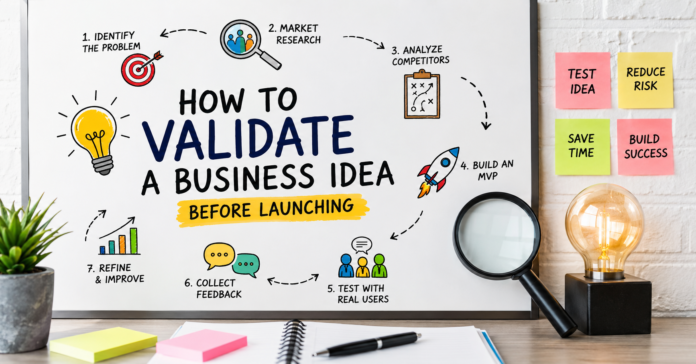
Wondering how to validate a business idea before launching? The best approach is to test real market demand before investing significant time or money. By researching your audience, analyzing competitors, creating a minimum viable product (MVP), and collecting customer feedback, you can reduce risk and improve your chances of success.
Key Takeaways
- Identify a real problem that people want solved.
- Research your target audience thoroughly.
- Analyze competitors and market demand.
- Build a simple MVP before full development.
- Gather feedback from potential customers.
- Test willingness to pay, not just interest.
- Use data to refine your idea before launch.
Why Business Idea Validation Matters
Many entrepreneurs make the mistake of building a product first and looking for customers later. Unfortunately, even great products can fail if there is no real market demand.
Learning how to validate a business idea before launching helps you:
- Reduce financial risk
- Save time and resources
- Understand customer needs
- Improve product-market fit
- Increase the likelihood of long-term success
A validated idea gives you confidence that people actually want what you’re planning to offer.
Define the Problem You Are Solving
Every successful business solves a problem.
Ask yourself:
- What challenge does my target customer face?
- How often does this problem occur?
- How serious is the pain point?
- Are people actively searching for solutions?
Example
If you want to launch a meal-planning app, the problem might be that busy professionals struggle to plan healthy meals throughout the week.
The stronger the problem, the greater the potential demand.
Pro Tip: Customers buy solutions to problems, not products.
Identify Your Target Audience
You cannot validate an idea without knowing who will use it.
Create a simple customer profile that includes:
| Category | Example |
|---|---|
| Age | 25–45 |
| Occupation | Working professionals |
| Location | Urban areas |
| Challenges | Lack of time |
| Goals | Save time and eat healthier |
Understanding your audience allows you to collect more accurate feedback and build a better solution.
Research Market Demand
Before launching, verify that people are actively looking for solutions.
Ways to Measure Demand
- Google Search trends
- Online communities and forums
- Social media discussions
- Customer surveys
- Industry reports
- Keyword research tools
Look for recurring questions, complaints, and unmet needs.
Demand Validation Checklist
| Question | Yes/No |
|---|---|
| Are people discussing the problem? | |
| Are competitors serving this market? | |
| Is search demand growing? | |
| Are customers willing to spend money? |
The more “Yes” answers you get, the stronger your opportunity.
Analyze Your Competitors
Competition is often a positive sign.
If competitors exist, it usually means there is market demand.
Study:
- Their products and services
- Pricing models
- Customer reviews
- Marketing strategies
- Strengths and weaknesses
Pay special attention to negative reviews. These often reveal opportunities for improvement.
Expert Insight: A crowded market is not necessarily bad. The key is finding a unique angle that differentiates your business.
Create a Minimum Viable Product (MVP)
An MVP is the simplest version of your product that solves the core problem.
Instead of spending months building a complete solution, launch something basic and test it.
MVP Examples
- Landing page
- Prototype
- Demo video
- Basic mobile app
- Service pilot program
- Pre-order campaign
The goal is to learn quickly and cheaply.
Collect Real Customer Feedback
Feedback from actual potential customers is invaluable.
Methods include:
- One-on-one interviews
- Online surveys
- Beta testing programs
- Social media polls
- Email questionnaires
Ask questions such as:
- Would you use this solution?
- What problem does it solve for you?
- What features are most important?
- What would make you choose it over competitors?
Listen carefully and look for patterns in responses.
Test Willingness to Pay
One of the biggest validation mistakes is confusing interest with purchasing intent.
Someone saying “That’s a great idea” does not guarantee a sale.
Instead, test:
- Pre-orders
- Subscription signups
- Deposit requests
- Paid beta access
- Pilot programs
If customers are willing to spend money before launch, your idea has strong validation.
Pro Tip: Revenue is one of the strongest forms of validation.
Measure Results and Refine
Validation is an ongoing process.
Track key metrics such as:
- Conversion rates
- Sign-up rates
- Customer acquisition costs
- Survey responses
- Retention rates
Use this data to improve your product, messaging, and business model before scaling.
A common bottleneck is ignoring customer feedback and building based on assumptions. Successful founders continuously adapt based on market insights.
Common Business Validation Mistakes
Avoid these costly errors:
- Falling in love with the idea instead of the problem
- Ignoring negative feedback
- Relying only on friends and family opinions
- Skipping competitor research
- Building too many features too early
- Assuming interest equals demand
The most successful businesses validate before they invest heavily.
Frequently Asked Questions
1. What is business idea validation?
Business idea validation is the process of testing whether customers actually want and will pay for your product or service before launching it.
2. How long does it take to validate a business idea?
It can take anywhere from a few weeks to several months, depending on the complexity of the product and the amount of customer research required.
3. What is an MVP?
An MVP (Minimum Viable Product) is a basic version of a product designed to test market demand with minimal investment.
4. Why is customer feedback important during validation?
Customer feedback helps identify real needs, improve your solution, and avoid building features that users do not value.
5. Can I validate a business idea without spending money?
Yes. Surveys, interviews, social media research, landing pages, and community engagement can provide valuable insights at little or no cost.
Understanding how to validate a business idea before launching can save you significant time, money, and frustration. Instead of relying on assumptions, gather real-world evidence through research, customer interviews, MVP testing, and payment validation. The more proof you collect before launch, the stronger your foundation for long-term success.
Start small, test quickly, learn from feedback, and refine your idea until the market confirms that it is worth pursuing. A validated business idea is the first step toward building a profitable and sustainable company.