
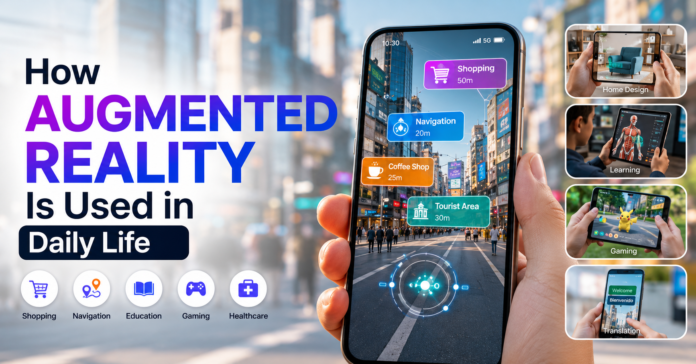
Augmented Reality (AR) is no longer a futuristic concept. It is already part of everyday life, helping people shop online, navigate cities, learn new skills, play games, and even improve workplace productivity. By blending digital elements with the real world, AR creates interactive experiences that make daily tasks easier, faster, and more engaging.
Key Takeaways
- AR overlays digital content onto the real world.
- It is widely used in shopping, education, healthcare, gaming, and navigation.
- AR helps users make better purchasing decisions.
- Businesses use AR to improve customer engagement.
- Mobile phones have made AR accessible to millions of people worldwide.
What Is Augmented Reality?
Augmented Reality (AR) is a technology that adds digital information, images, animations, or virtual objects to a real-world environment through smartphones, tablets, or AR glasses.
Unlike Virtual Reality (VR), which creates a completely virtual environment, AR enhances the real world by adding interactive digital elements.
AR vs. VR Comparison
| Feature | Augmented Reality (AR) | Virtual Reality (VR) |
|---|---|---|
| Environment | Real world + digital elements | Fully virtual world |
| Device | Smartphone, tablet, AR glasses | VR headset |
| User Awareness | Remains aware of surroundings | Immersed in virtual space |
| Daily Use | Shopping, navigation, education | Gaming, simulations |
How Augmented Reality Is Used in Daily Life
AR in Online Shopping
One of the most common uses of AR is in e-commerce.
Many retailers allow customers to visualize products before buying them. For example, shoppers can place virtual furniture in their living rooms or see how a pair of glasses looks on their face.
Benefits include:
- Better buying decisions
- Reduced product returns
- Enhanced customer satisfaction
- Improved shopping confidence
Pro Tip: AR shopping tools help consumers understand product size, color, and fit before making a purchase.
AR for Navigation and Maps
Modern navigation apps use AR to provide real-time directions.
Instead of simply showing a map, AR overlays arrows and navigation instructions directly onto the street view through a smartphone camera.
This helps users:
- Find destinations faster
- Avoid confusion in unfamiliar areas
- Improve walking navigation accuracy
Traditional Navigation vs AR Navigation
| Feature | Traditional Maps | AR Navigation |
|---|---|---|
| Visual Guidance | Basic map view | Real-world overlays |
| Ease of Use | Moderate | High |
| Accuracy | Good | Excellent |
| User Experience | Standard | Interactive |
AR in Education and Learning
Educational institutions increasingly use AR to create interactive learning experiences.
Students can:
- Explore 3D models of the human body
- View historical landmarks virtually
- Understand complex scientific concepts
- Engage in immersive learning activities
When deploying AR in education, learners often retain information better because they interact with visual content rather than just reading text.
AR in Gaming and Entertainment
Gaming has played a major role in making AR popular.
AR games combine physical surroundings with digital gameplay, creating immersive experiences that encourage movement and exploration.
Benefits include:
- Increased engagement
- Interactive storytelling
- Physical activity
- Enhanced social interaction
Entertainment companies also use AR filters, effects, and virtual experiences on social media platforms.
AR in Healthcare
Healthcare professionals use AR for training, diagnostics, and patient education.
Applications include:
- Surgical assistance
- Medical training simulations
- Anatomy visualization
- Rehabilitation exercises
Expert Insight: AR helps medical professionals visualize complex procedures before performing them, improving accuracy and confidence.
AR in Home Improvement and Interior Design
AR simplifies home decoration and renovation projects.
Homeowners can virtually place furniture, paint walls, and test different room layouts before making changes.
Popular uses include:
- Furniture placement
- Kitchen remodeling previews
- Wall color testing
- Space planning
This reduces costly mistakes and improves design decisions.
AR in Workplace Productivity
Businesses are increasingly adopting AR tools to improve efficiency.
Employees can receive real-time instructions, training support, and visual guidance while performing tasks.
Common workplace applications include:
- Equipment maintenance
- Employee training
- Manufacturing support
- Remote collaboration
A common bottleneck in technical work is understanding complex procedures. AR solves this by displaying step-by-step instructions directly in the user’s field of view.
Benefits of Using Augmented Reality Daily
AR offers several advantages for both consumers and businesses.
Key Benefits
- Enhanced user experiences
- Faster decision-making
- Improved learning outcomes
- Greater customer engagement
- Reduced operational errors
- Increased productivity
As smartphone technology continues to evolve, AR experiences are becoming more realistic and accessible.
The Future of Augmented Reality
The future of AR looks promising. Advancements in artificial intelligence, wearable technology, and smart glasses are expected to make AR even more integrated into daily life.
Future developments may include:
- AR-powered smart glasses
- Virtual workspaces
- Advanced healthcare solutions
- Personalized shopping experiences
- Real-time language translation
As adoption grows, AR is likely to become as common as smartphones are today.
Frequently Asked Questions (FAQs)
1. What is augmented reality in simple terms?
Augmented Reality is a technology that adds digital images, information, or objects to the real world using devices like smartphones or tablets.
2. How is AR different from VR?
AR enhances the real world with digital elements, while VR creates a completely virtual environment that replaces the real world.
3. Can I use AR on my smartphone?
Yes. Most modern smartphones support AR applications for shopping, gaming, navigation, education, and entertainment.
4. Is augmented reality only used for gaming?
No. AR is widely used in healthcare, education, retail, navigation, manufacturing, and workplace training.
5. What are the main benefits of AR?
AR improves user experiences, increases engagement, enhances learning, supports better decision-making, and boosts productivity.
Augmented Reality has moved beyond entertainment and become a practical technology that improves everyday life. From shopping and education to healthcare and navigation, AR helps people interact with digital information in more meaningful ways. As technology advances, its role in daily activities will continue to expand, making tasks more efficient, interactive, and convenient.
Want to stay updated on emerging technologies like AR, AI, and smart devices? Explore more technology guides and discover how innovation is shaping the future of everyday life.